
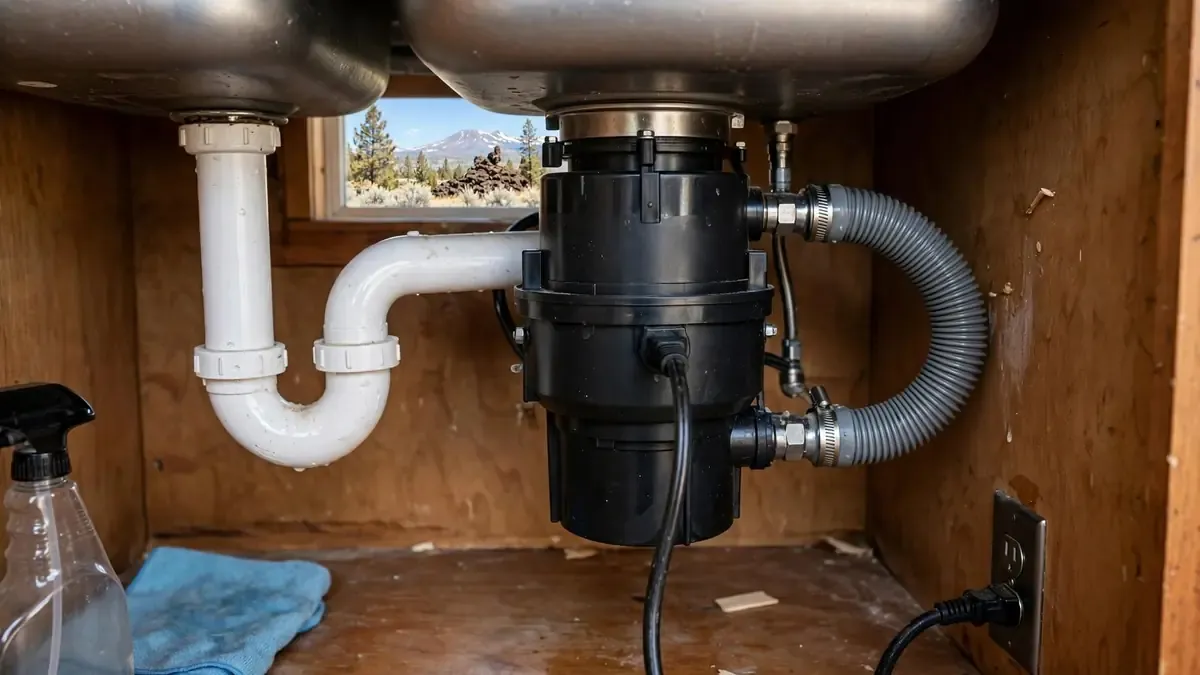
The short answer: one bowl feeds the disposal and the other joins it
On a typical double sink, one bowl drains straight into the disposal. The other bowl drains through a tailpiece and a short horizontal pipe, which connects to the disposal's side outlet or to a branch fitting just beyond it. Everything then flows through a single trap and into the wall drain.
That layout is simple, but it has several joints that can leak. A wrong slope on the horizontal pipe also causes standing water in one bowl, which people often blame on the disposal. Most double-sink problems come down to alignment, slope and a missed connection.
How the parts connect
Follow the water from the sink to the wall.
- Bowl one: flange and disposal. A mounting assembly seals the sink opening and holds the disposal underneath.
- Bowl two: strainer and tailpiece. A drain assembly drops into a tailpiece that runs toward the disposal discharge.
- Discharge elbow and trap arm. The disposal outlet and the second bowl's pipe join, then pass through a P-trap.
- Dishwasher drain. A hose from the dishwasher attaches to a nipple on the disposal, after the knockout plug is removed.
Disposal leaking or sink backing up?
Call and describe which bowl is slow and where the water shows.
Problems that show up on a double-sink setup
Most of these can be traced to one joint.
| Symptom | Likely cause | Fix |
|---|---|---|
| Second bowl drains slowly | Horizontal pipe sloped the wrong way or clogged | Re-pitch the pipe and clear the line |
| Leak under the disposal | Loose mounting ring or failed gasket | Tighten, replace the gasket, or replace the unit |
| Dishwasher backs up into the sink | Knockout plug left in or a clogged hose | Remove the plug and clean the hose |
| Gurgling when both bowls drain | Vent issue | Check the vent and trap arm length |
| Odor from the sink | Food buildup in the disposal or a dry trap | Clean, and run water to refill the trap |
The knockout plug that stops dishwashers
A new disposal comes with a plastic plug inside the dishwasher inlet. If the dishwasher is connected without removing it, the machine cannot drain and water backs up into the dishwasher tub. People often think the dishwasher has failed.
Remove the plug with a screwdriver and a hammer before connecting the hose, and take the plug out of the unit so it does not clog the grinder. The hose should loop high under the counter, or run through an air gap, so that sink water cannot flow backward.
Choosing a disposal for a two-bowl sink
Horsepower, feed type and sound insulation are the main choices. A continuous-feed unit runs while you push scraps in, and a batch-feed unit runs only when the stopper is turned. Larger motors resist jams better, and models with insulation run quieter.
Check the sink first. A disposal needs a standard 3.5 to 4.5 inch drain opening, and some older or specialty sinks need an adapter. The plumber confirms fit and clearance under the sink, since a deep disposal may hit the trap on a shallow cabinet.
Installing a disposal on a double sink: the order that works
Start by shutting off power at the breaker, since a disposal is wired or plugged in beneath the sink. Remove the old strainer or the old disposal, clean the opening and set the new mounting flange on a bead of plumber's putty. Tighten it from below until the putty squeezes out evenly and wipe the excess away.
Hang the disposal on its mounting ring and rotate it until the discharge outlet lines up with the drain pipe. Connect the second bowl's tailpiece to the same drain with a continuous waste fitting. Check that the horizontal run slopes gently toward the wall so water does not stand in the pipe.
Last, connect the dishwasher hose, the P-trap and the power. Fill both bowls and release them together while you watch every joint. A slow weep at a slip nut shows up under load, so run the test before you close the cabinet.
Noise, smell and upkeep
A disposal that growls or rattles may have a utensil in the chamber, and a unit that runs but hums needs the jam cleared. Smells come from food film on the shredder ring and the underside of the splash guard. Scrub them with a brush and dish soap, then run cold water to flush the chamber.
Citrus peels and ice are common suggestions for freshening a disposal, but they do not fix buildup. Regular cleaning and cold water do more. If the drain line is the source of the odor, a drain cleaning visit clears the line behind the trap.
Derry notes if you plan to install or replace one
Derry's code enforcement office at 603-432-6148 can tell you whether a permit applies to kitchen plumbing work in your house. Ask before you start, especially if the project moves drains or vents.
Homes in Derry that are on septic systems need extra thought. A disposal sends more solids to the tank, so the state's private well and septic guidance and your septic contractor are the people to ask before adding one.
Sources: derrynh.gov code enforcement contact. general septic guidance from the property's septic contractor.
Next steps
If your disposal has jammed or leaked, read our garbage disposal repair page. For a remodel that moves the sink, the plumbing installation page explains rough-in and permits. We work in Derry and in Londonderry and Salem.
Frequently asked questions
Yes. Both bowls usually join before a single P-trap, as long as the pipes are sized and sloped correctly. Two separate traps are not needed unless local rules require them.
That usually points to a clog or a wrong slope on the second bowl's horizontal pipe. A plumber can clear and re-pitch it.
It depends on local plumbing rules. A high loop in the hose works in many installations. The plumber installs what the code in your town calls for.
Replacing an existing unit often takes about an hour. A new install with wiring or a drain change takes longer.
Many septic systems can handle light use, but heavy use fills the tank faster. Ask your septic contractor before you add one.
Kitchen sink plumbing done right
Call for disposal repair or installation in Derry.